
A shower hose rarely fails from age alone. It fails from being coiled the wrong way, left twisted at the connection, or stored somewhere it shouldn't be, and all three are avoidable with habits that take seconds.
Prevent kinks by coiling the hose in wide, even loops rather than folding it tightly, and by hanging or resting it in its bracket between uses rather than letting it drape or pile on the shower floor. Prevent twists by checking the hose isn't turning on itself when you lift the handheld and reconnecting it straight if it does. Prevent cracks by keeping the hose away from prolonged direct heat and, if it's a rubber or PVC-lined hose rather than metal, out of continuous direct sunlight if the shower is near a window. Most hose failures trace back to one of these three habits, not to a faulty product.
Why Shower Hoses Fail Before Anything Else in the Set
A shower hose does more mechanical work than any other part of a shower set. The head and valve stay fixed in place; the hose bends, twists, coils, and stretches every time the handheld is lifted, used, and put back. That repeated flexing is exactly why hoses are usually the first component to show wear in an otherwise healthy shower set.
Most shower hoses are one of two constructions:
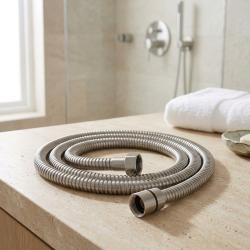
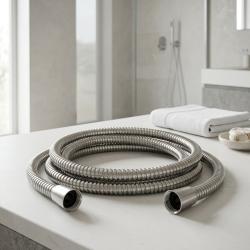
- Stainless steel braided hoses use interlocking metal coils or a woven steel mesh over an inner rubber or silicone core. They resist kinking well because the metal structure holds its shape, but a sharp, repeated crease in the same spot can eventually fatigue the metal and cause a leak at that point.
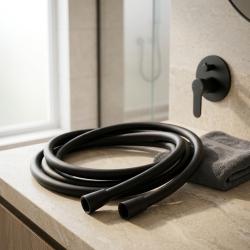
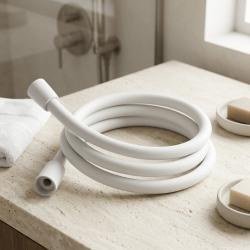
- Reinforced rubber or PVC hoses are more flexible and often lighter, but they're more prone to kinking under tight folds and can degrade faster under heat or UV exposure, since the material itself is less heat-stable than steel.
Knowing which type you have changes which of the three failure modes, kinks, twists, or cracks, is the bigger risk for your specific hose.
Kinks: The Most Common and Most Preventable Failure
A kink happens when the hose is bent sharply enough to crease rather than curve, restricting or blocking water flow at that point and, over repeated bending in the same spot, weakening the material until it splits.
What causes kinks:
- Coiling the hose into a tight loop for storage instead of a wide, loose one
- Letting the hose fold under itself when the handheld is set down on the shower floor or tray
- Closing a shower door or screen on part of the hose
- Storing the hose stuffed into a cabinet where it's forced into a sharp bend
How to prevent them:
- Coil the hose in loops at least 15-20cm in diameter when storing it loose; smaller loops are what create the sharp bend that eventually creases.
- Use the hose's wall bracket or holder if one is included, rather than letting the hose hang free or pool on the shower floor between uses.
- If a kink has already formed, gently straighten the hose by hand rather than pulling hard on both ends, which can stress the material further at the crease point.
Twists: Why the Handheld Turns and the Hose Doesn't
A twist builds up gradually as the handheld unit is rotated slightly each time it's lifted, used, and reattached, since most hose connections allow some rotation at the fitting. Over weeks or months, that small rotation accumulates into a visible spiral along the hose's length.
A twisted hose is more prone to kinking, since the spiral shape puts the material under a slight tension that makes it easier to crease under an otherwise normal bend.
How to prevent it:
- Every few weeks, let the hose hang free (disconnected from the handheld, or with the handheld held loosely) and allow it to unwind naturally under its own weight.
- When reattaching the handheld after cleaning it, check that the connection sits straight rather than screwed on at a slight angle, which encourages twisting over time.
- If a hose has a swivel connector at one or both ends, this largely prevents twist buildup, since the fitting rotates independently of the hose itself. Check whether your hose has this feature if twisting is a recurring issue.




Cracks: What Actually Degrades the Material
Cracking is different from kinking: it's the material itself breaking down rather than a single stress point failing. It shows up as fine surface lines, usually near a connection point or along a section that gets bent repeatedly, and it means the hose needs replacing rather than repairing.
Common causes of cracking:
- Prolonged heat exposure, such as a hose resting against a heated towel rail or positioned too close to a shower's heat source
- UV exposure, if the shower is near a window and the hose is a rubber or PVC-lined type rather than metal-braided
- Repeated bending at the exact same point over months or years, which is a slower version of the same fatigue that causes kinking
- Harsh cleaning chemicals, particularly bleach or ammonia-based products, which can degrade the outer layer of a rubber or PVC hose over repeated exposure
How to slow it down:
- Keep the hose away from direct contact with a heated towel rail or other heat source.
- Clean the hose with warm water and a mild pH-neutral soap rather than a harsh multi-surface cleaner (see cleaning section below).
- Inspect the hose every few months for fine surface cracking, especially near the connection points, since this is where flexing stress concentrates most.
Kink vs. Twist vs. Crack: Quick Reference
|
Kink |
Twist |
Crack |
|
|
What it looks like |
A sharp bend or crease |
A visible spiral along the hose length |
Fine surface lines, usually near a connection |
|
Main cause |
Tight coiling or folding |
Handheld rotating slightly on reattachment |
Heat, UV, or chemical exposure over time |
|
Fixable? |
Often, by gently straightening early |
Yes, by letting the hose unwind periodically |
No, once visible, the hose needs replacing |
|
Most affected hose type |
Rubber/PVC more than steel-braided |
Both, but worse on smoother hose surfaces |
Rubber/PVC more than steel-braided |
|
Prevention |
Wide loops, use the wall bracket |
Periodic unwinding, check connection alignment |
Keep away from heat sources, use pH-neutral cleaners |
Cleaning Without Accelerating Wear
A hose that's cleaned with the wrong products degrades faster than one that's simply used daily and left alone.
- Wipe the hose down with a damp microfiber cloth and a few drops of pH-neutral soap in warm water, focusing on the connection points at both ends where limescale and grime build up fastest.
- Rinse with a clean, damp cloth to remove soap residue.
- Dry the hose, particularly the connection threads, since trapped moisture at a joint is a common cause of early corrosion on a steel-braided hose and can encourage mold or mildew on a rubber one.
- Avoid bleach, ammonia, and abrasive scouring pads entirely; these degrade the outer material faster on a rubber or PVC hose and can dull or pit a steel-braided hose's finish over repeated use.
Storage and Everyday Habits
- Use the wall bracket or holder if the shower set includes one; this is the single most effective habit for preventing both kinks and prolonged moisture exposure at the base.
- Avoid letting the hose coil on the shower floor or tray between uses, where it's more likely to be stepped on, caught in a door, or folded into a tight kink.
- If storing the hose away from the shower (during a renovation, for example), coil it loosely and secure it with a soft tie rather than a tight rubber band, which can crease the material at the binding point.
- Check the connection points periodically for looseness. A hose that isn't fully tightened at the fitting can develop a slow leak that looks like a hose failure but is actually a connection issue, an easy fix that doesn't require replacing the hose.
Common Mistakes
- Coiling the hose into a small, tight loop to save space in a cabinet
- Letting the handheld dangle and spin freely after use instead of returning it to its bracket
- Using a bleach-based bathroom cleaner on the hose because it's the same product used on tile and grout
- Ignoring a slow leak at the connection point, assuming it means the whole hose needs replacing
- Positioning a heated towel rail close enough that the hose rests against it regularly

Most shower hose problems come from three preventable habits: tight coiling, unmanaged twisting, and heat or chemical exposure. None of them require special products or more than a few seconds of attention, using the wall bracket, letting the hose unwind occasionally, and cleaning it gently rather than with whatever's already under the sink.
FAQ
Why does my shower hose keep kinking in the same spot?
Repeated bending at the same point weakens the material there, making it easier to crease again in the future. Once a hose kinks repeatedly at one spot, gently straightening it helps short-term, but the weakened point is more prone to failure going forward.
Is it normal for a shower hose to twist over time?
Yes, especially with hoses that lack a swivel connector at the handheld end. The handheld rotates slightly each time it's lifted and reattached, and that small rotation accumulates. Letting the hose hang and unwind periodically prevents it from building up further.
Can a cracked shower hose be repaired, or does it need replacing?
Once cracking is visible, the hose needs replacing rather than repairing. Cracking indicates the material itself has degraded, and there's no reliable way to restore its integrity at that point.
Are steel-braided hoses better than rubber or PVC hoses?
Steel-braided hoses generally resist kinking and UV degradation better, since the metal structure holds its shape and isn't affected by sunlight the way rubber or PVC can be. Rubber and PVC hoses are typically lighter and more flexible, which some people prefer for handling, at the cost of being more prone to kinking and heat or UV-related cracking.
Can I use bleach to clean a shower hose?
It's best avoided. Bleach and other harsh chemicals can degrade a rubber or PVC hose's outer material over repeated exposure and can dull or pit the finish on a steel-braided hose. A pH-neutral soap and warm water handles routine cleaning safely.
Why is there a small leak at my shower hose connection?
This is usually a loose fitting rather than a failure in the hose itself. Check that both connection points are fully tightened; a persistent leak after tightening may indicate a worn washer inside the fitting, which is a smaller and cheaper fix than replacing the whole hose.
How long should a shower hose last?
With good storage habits, kept away from tight coiling, heat sources, and harsh chemicals, a quality hose can last many years. Most premature failures come from preventable wear, kinking, twisting, or chemical damage, rather than the hose simply reaching the end of its expected life.
Does hose length affect how likely it is to kink or twist?
A longer hose has more material to manage and can be more prone to tangling in storage if not coiled properly, but length itself isn't the main factor. How the hose is stored and used day to day matters more than how long it is.